
If the same black coffee tastes good one day and disappointing the next, the cause is usually not one mysterious failure. Small differences in coffee amount, grind, water, temperature, brew time, technique, or coffee age can stack up. You don’t need perfect repetition between carafes but making the routine consistent enough that you can tell which variable actually matters can help you understand the changes you’re tasting.
That turns an annoying experience into a diagnostic one. Instead of asking, “Why is my coffee random?” you can ask, “What changed enough to matter?”
Small Changes Can Add Up to a Different Cup
Brewing coffee involves several variables at the same time. The Specialty Coffee Association‘s brewing research has long treated coffee-to-water ratio, extraction, and beverage strength as connected instead of isolated ideas ideas. Other work shows that grind, brew temperature, flow, basket geometry, and water can also affect the result.
At home, you do not need to measure every one of those variables. You only need to recognize that several small shifts can combine into a cup that tastes noticeably different.
A slightly fuller scoop, a different water level, a grinder that retained a little coffee, and a slower brew may each be minor. But together, they can change what you taste.
Start With the Variables That Are Easiest to Repeat
First stabilize the two quantities that most directly define the recipe so the rest of the troubleshooting has a reliable baseline: coffee amount and water amount.
Coffee Amount
Use the same amount of coffee in a way you can repeat. If you use a scoop, fill it the same way each time. If you use a scale, use the same dose.
The exact number matters less at first than consistency. You are creating a stable reference point.
Water Amount
Do the same with water. Use the same brewer markings, measuring vessel, or weighed amount.
If the coffee amount and water amount both drift, you can change beverage strength without realizing it. Stabilizing those two variables removes the easiest source of confusion.
TBCL’s Coffee Ratios Explained Simply for Black Coffee Drinkers explains how those amounts work together.
Grind Variation Can Change the Cup Even at the Same Setting
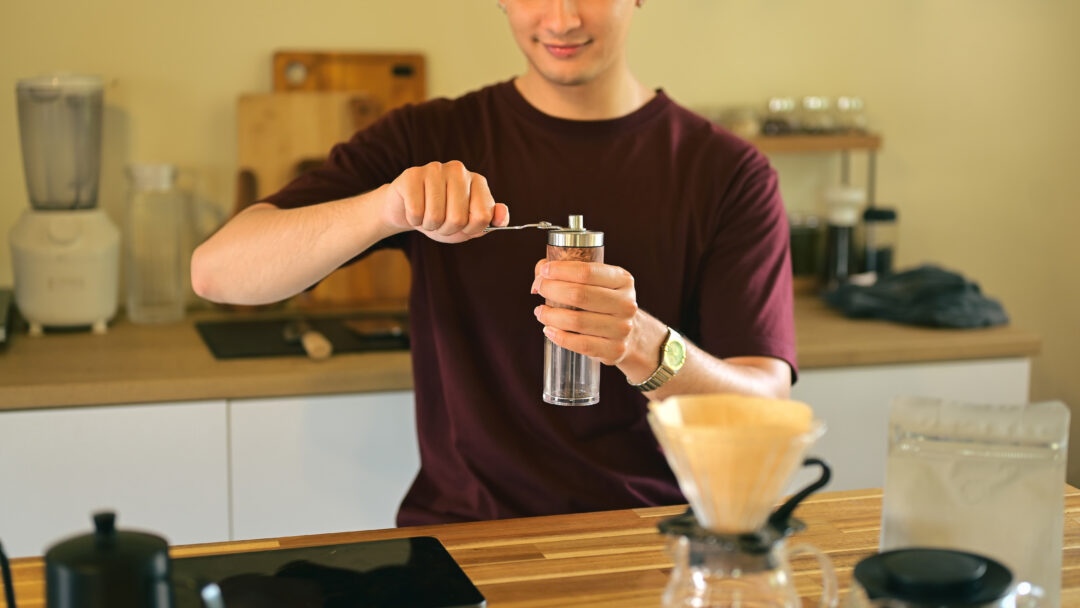
If you use a coffee grinder, particle distribution, retained grounds, dose, heat, burr condition, and the way beans feed through the grinder can all influence how the coffee extracts.
The SCA has discussed grinder instability as an important source of extraction variation, particularly in high-use settings. Home grinders operate under less demanding conditions, but the underlying lesson still applies: the same numbered setting does not guarantee that every dose behaves identically.
Before blaming the grinder, make sure the dose and water are reasonably stable. If the rest of the routine is repeatable and the cup still swings significantly, grind consistency becomes more plausible.
That is the point where Do You Actually Need a Better Coffee Grinder for Black Coffee? becomes useful.
Water and Temperature Can Shift More Than You Expect
Water affects extraction and flavor, while temperature affects how brewing progresses. The SCA’s brewing research has shown that temperature can influence the process even though final strength and extraction remain especially important to the sensory result.
For a home drinker, the practical question is simpler than the science. Are you starting with water that is similarly hot each time? Is the brewer fully heated? Has an automatic machine changed its behavior because of scale buildup, a different batch size, or a cold carafe?
Water composition can also change when you switch between tap, filtered, bottled, or softened water. TBCL’s Your Water Is Probably the Problem: The Best Water for Black Coffee owns that deeper topic.
Do not try to correct temperature and water chemistry simultaneously. Keep one stable while you investigate the other.
The Coffee Itself Changes After You Open the Bag
Coffee is not perfectly static after roasting or after the bag is opened. Aroma compounds fade, gases dissipate, and the cup may gradually seem flatter or less expressive.
That can make a familiar recipe feel as though something went wrong even when your brewing routine has not changed much.
If the cup became different gradually rather than suddenly, freshness deserves more attention than equipment. TBCL’s Why Your Black Coffee Tastes Flat After Day 10 covers that pattern in more depth, while How To Store Coffee Beans for Better Black Coffee addresses storage.
Your Brewing Technique Is Probably Less Identical Than It Feels

Even a familiar routine contains small human variations. Manual brews show them most clearly, but automatic brewers still depend on setup choices that can change from one day to the next.
Pouring
In manual brewing, the speed and location of your pour can change how water moves through the grounds. Even when you follow the same recipe, your hand motion is not a machine-controlled constant.
Agitation
Stirring, swirling, shaking, or even the force of the water stream can change how the grounds interact with water. More agitation is not automatically better. The important point is that changing it changes the brew.
Brew Time
A brew that runs noticeably faster or slower than usual is a useful clue. Grind, dose, filter behavior, pouring, and coffee age can all influence contact time.
Machine Routine
Automatic brewers reduce manual variation but do not eliminate it. A different water fill, coffee bed, filter placement, cleanliness level, or batch size can still shift the result. If you use an automatic brewer, consistency often improves by making preparation boring on purpose: same filter placement, same dose, same water amount, same basic setup.
Your Perception Can Change Too
Not every difference is in the brewer.
Coffee temperature changes what you can smell and taste. Food, toothpaste, another beverage, or simply comparing the cup with something you drank earlier can alter what stands out to you. A coffee that seemed intensely bitter yesterday may seem more balanced today even if the recipe was similar.
This does not mean the difference is “in your head.” Taste is an interaction between the beverage and your sensory system. The practical response is the same: avoid making a major brewing change based on one unusual cup.
Look for a pattern across several brews.
Use a Simple One-Week Consistency Check

You do not need a tasting journal. For one week, keep the same coffee and brewing method and note only a few things:
- Coffee amount.
- Water amount.
- Grind setting or grinder method.
- Approximate brew time, if you can observe it easily.
- One short description of the cup.
Do not change the recipe every morning. If one cup is disappointing, record it and repeat the same setup once more.
After several brews, look for a pattern. Perhaps the weak cups happened when the water amount drifted. Perhaps the slow cups were more bitter. Perhaps the coffee simply became flatter as the bag aged.
A small record turns memory into evidence without turning breakfast into an experiment.
When Equipment Is Worth Investigating
Equipment deserves attention when a repeatable routine still produces repeatable problems.
A grinder becomes more relevant when the dose and recipe are stable but extraction behavior varies. A scale becomes more relevant when you cannot reproduce coffee and water amounts reliably. A brewer becomes more relevant when temperature, flow, or brew time behaves inconsistently despite the same setup.
This order matters because replacing equipment before stabilizing the routine can hide the original problem rather than solve it.
If measurement itself seems uncertain, Do You Need a Coffee Scale to Make Better Black Coffee? is the better next decision page.
Stabilize One Variable Before You Change Anything Else
The goal is not to make every cup identical. Coffee is a sensory product, and some variation is normal.
The goal is to create enough consistency that a change teaches you something.
Start with coffee and water amounts. Then pay attention to grind and brew time. Keep water and technique reasonably stable. If a pattern appears, change one variable and compare again.
A routine you can repeat is more useful than a complicated recipe you cannot diagnose.