
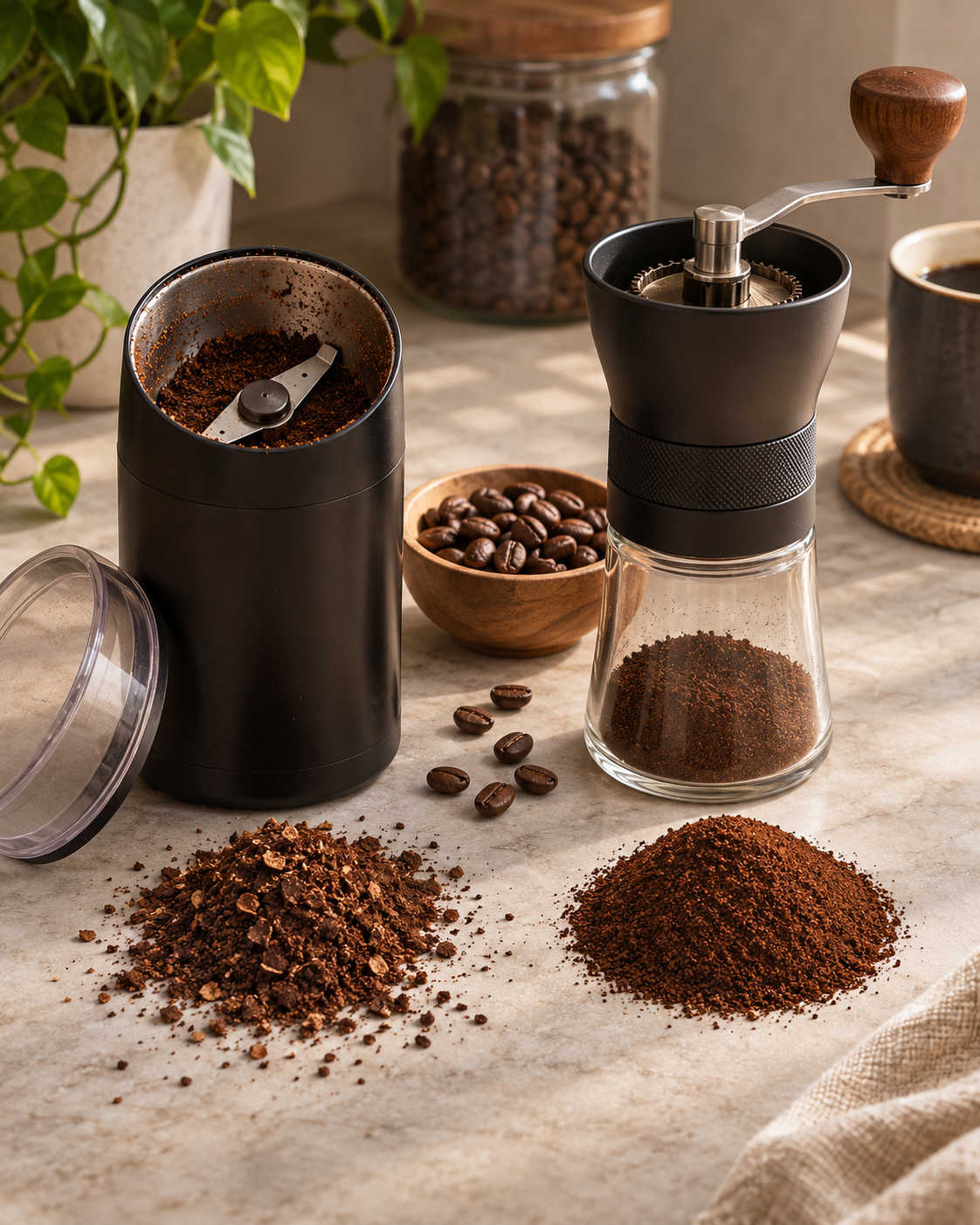
A burr grinder gives you more control over grind size and usually more repeatable results than a blade grinder. That matters most when your coffee dose, water, and brewing process are already stable enough for grind inconsistency to become the limiting variable. A blade grinder can still make drinkable black coffee when low cost and simplicity matter more than precise control.
The useful question is not whether burr grinders are “better” in the abstract but whether better grind control would solve a problem you actually have.
Burr and Blade Grinders Do Different Jobs
A blade grinder uses a spinning blade to chop coffee. The longer it runs, the smaller the average pieces become, but there is no fixed gap controlling particle size. The same batch usually contains a mix of smaller and larger particles.
A burr grinder passes beans between two grinding surfaces separated by a set distance. Changing that distance gives you a repeatable way to make the grind coarser or finer.
Neither system produces perfectly identical particles. Coffee grinding always creates a distribution of sizes. The practical advantage of a burr grinder is that the distribution and the adjustment are usually easier to control from one brew to the next.
Why Particle-Size Consistency Changes Brewing Feedback
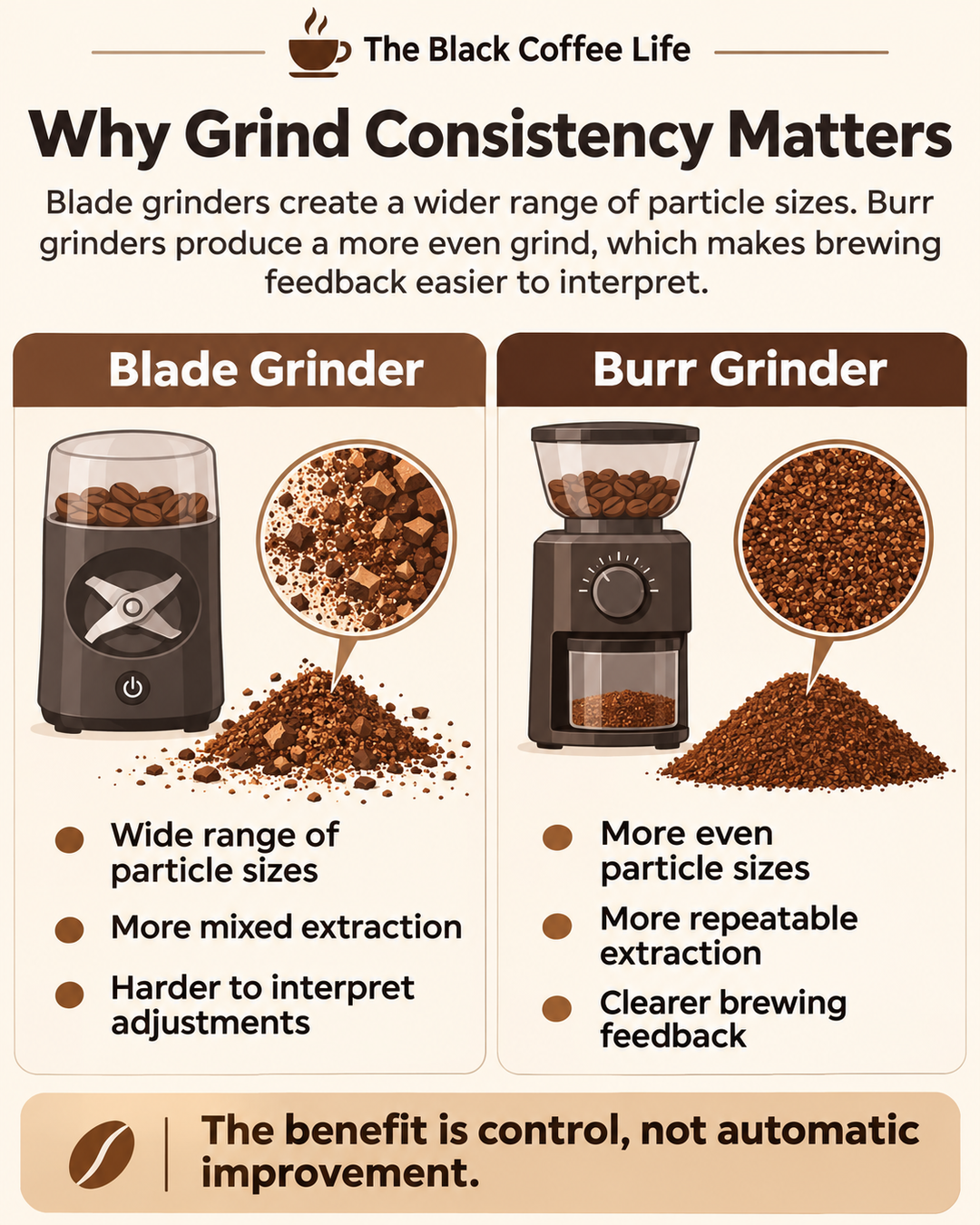
Water extracts coffee from particle surfaces. Smaller particles expose more surface area relative to their mass, while larger particles generally extract more slowly. Particle-size distribution matters because differently sized particles extract at different rates.
That does not mean every fine particle automatically tastes bitter or every coarse particle automatically tastes sour. Real brewing is more complicated than that. Flow, contact time, agitation, water, roast, and brewing method all interact with grind.
For a home coffee drinker, the important effect is feedback. If grind distribution changes unpredictably, a recipe can respond differently even when you think you made the same adjustment. A more controllable grinder can make cause and effect easier to see.
What You Can Control With Each Grinder
The category difference becomes easier to understand when you separate three practical questions: can you choose a grind size, can you repeat it, and how much complexity are you willing to add?
Grind-Size Control
With a blade grinder, grind size is mostly controlled by time and technique. A short run leaves larger pieces. A longer run creates more small particles, but it also continues chopping everything already in the chamber.
A burr grinder gives you discrete or stepless settings. That makes it easier to say, “This setting was too coarse, so I will move slightly finer” and then repeat that change later.
Repeatability
Repeatability is where the difference often becomes useful. If you return to the same burr setting with the same coffee and dose, you have a better chance of starting from a similar grind than you do by trying to reproduce a blade-grinder run by feel.
That does not guarantee identical cups. Retention, bean condition, static, burr condition, and normal particle variation still exist. But the grinder can remove some uncertainty.
Convenience and Cost
Blade grinders are inexpensive, compact, and easy to understand. If you already own one and enjoy the coffee it produces, there may be no urgent reason to replace it.
Burr grinders cost more and take up more space, and some require cleaning, calibration, or more deliberate use. The benefit is control, not automatic improvement.
When a Blade Grinder Is Good Enough
A blade grinder can be good enough when your brewing method is forgiving, your routine is simple, and the cup already tastes satisfying most days.
Immersion methods can often tolerate more grind variation because extraction is less dependent on water flowing evenly through a coffee bed. Automatic drip can also be somewhat forgiving in everyday use, but grind size still affects flow, extraction, and repeatability. If you are not trying to dial in small grind changes, the extra precision of a burr grinder may not change your daily experience enough to justify the purchase.
It can also make sense to keep using a blade grinder while you stabilize more basic variables. If your coffee-to-water ratio changes every day or your brewing technique is still inconsistent, a new grinder may give you more settings without giving you clearer answers.
When the Burr Grinder Difference Becomes Noticeable
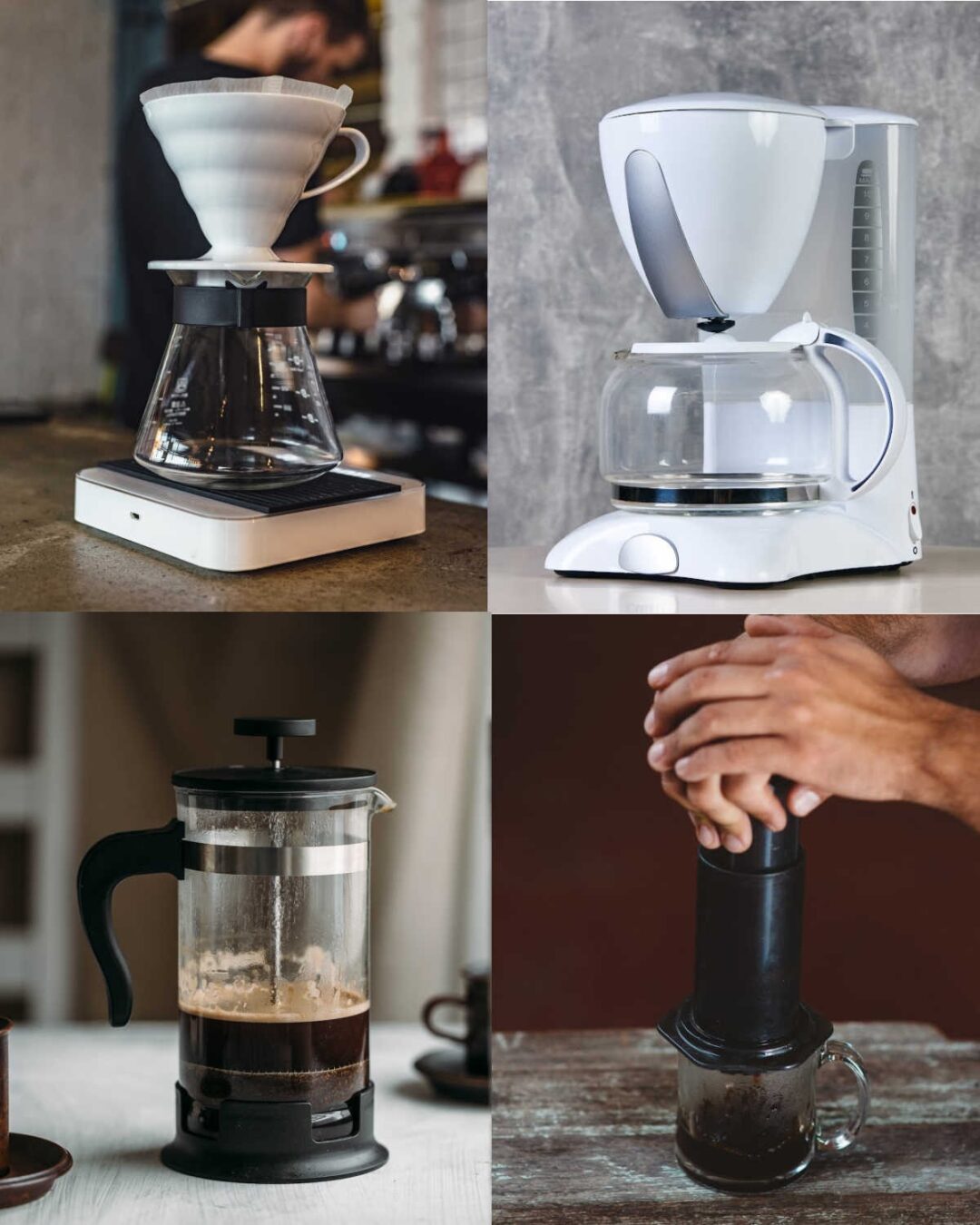
The upgrade becomes more meaningful once the rest of the brewing process is repeatable. Different methods expose grinder limitations in different ways, so the threshold is not the same for everyone.
Pour-Over and Other Flow-Sensitive Brewing
Pour-over depends on how water moves through a bed of coffee. Grind size and particle distribution can affect both extraction and flow rate. When the grind is inconsistent, drawdown can become harder to predict and small recipe changes may not behave the same way twice.
This is where a burr grinder’s repeatable adjustment can become especially useful. You can move finer or coarser and observe the result without wondering whether the entire particle mix changed in an uncontrolled way.
Espresso as an Edge Case
Espresso makes grind control even more important because small grind changes can materially affect flow through the puck and therefore the resulting extraction.
TBCL is not primarily an espresso site, so that does not need to drive the purchase decision for a reader who makes drip coffee. It simply illustrates why grinder precision matters more as the brewing method becomes less forgiving.
Automatic Drip and Immersion
For automatic drip, French press, AeroPress-style immersion, and similar methods, the difference may be more subtle. A burr grinder can still improve repeatability, but the brewer may tolerate more variation before the cup becomes obviously inconsistent.
If your coffee tastes good and changes predictably when you adjust ratio or grind, the blade grinder may not be your limiting factor yet.
A Burr Grinder Will Not Fix Everything
A burr grinder cannot make stale coffee fresh, fix unsuitable water, stabilize a changing coffee-to-water ratio, or repair a brewer with inconsistent temperature or flow.
It also can’t guarantee that you’ll prefer the result. A coffee can be evenly ground and still be too dark, too bright, too light-bodied, or simply not to your taste.
That is why the broader TBCL grinder guide treats an upgrade as a feedback tool rather than a magic flavor upgrade. Better equipment becomes most useful after the process around it is stable enough to benefit.
If You Upgrade, What Actually Matters
You do not need to compare dozens of grinder features to make a useful upgrade decision. A few category-level characteristics matter more than marketing language.
- Usable grind range for the brewing methods you actually use.
- Adjustment that is easy to repeat.
- Reasonable retention and cleanup for your routine.
- Capacity that matches your normal batch size.
- Workflow you will actually tolerate every morning.
Manual burr grinders can offer strong grind control at a lower price, but they require physical effort. Electric burr grinders trade some cost and counter space for speed and convenience.
Conical versus flat burr geometry can matter in specialized comparisons, but it’s not necessary for deciding whether to move from a blade grinder to a burr grinder in the first place.
Decide Based on the Problem You Have Now
Keep the blade grinder if your routine is simple, your coffee is satisfying, and grind variation is not preventing you from learning from adjustments.
Consider a burr grinder when your dose, water, coffee, and brewing method are stable but the cup still responds unpredictably to grind changes, or when your brewing method needs more precise grind control.
That is the threshold that matters. The purchase makes sense when better control removes a real uncertainty, not when owning a blade grinder starts to feel like a beginner mistake.
For the broader question of whether any grinder upgrade is worth making at your current stage, see Do You Actually Need a Better Coffee Grinder for Black Coffee?